
The Shift from Separate Security Programs to Connected Risk | Myth vs The Truth
For years, organizations structured security programs around a simple divide. IT teams managed cyber security and networks, while physical security teams handled buildings, access control, and on-site protection. Each operated with different priorities, budgets, and reporting lines.
This model made sense when systems were isolated. However, the rise of operational technology (OT environments) has fundamentally changed how infrastructure operates. Industrial control systems, building management systems, and access control platforms are now connected to corporate networks. Physical infrastructure is no longer standalone. It is part of a broader, integrated digital ecosystem.
As a result, risk no longer stays within one domain. It moves across systems, often undetected until it impacts operations.
How OT Environments Connect Cyber and Physical Security
Modern OT environments rely on interconnected systems to support efficiency, monitoring, and automation. These include industrial control systems, SCADA networks, and smart building technologies. While this connectivity improves operational visibility, it also creates shared dependencies between cyber security and physical security.
For example, access control systems often run on IP-based networks. Surveillance systems store and transmit data through the same infrastructure used for operational processes. Industrial systems connect to corporate environments for remote monitoring and maintenance.
This convergence means that a vulnerability in one area can directly impact another. Cyber security is no longer limited to protecting data. It now plays a critical role in protecting physical infrastructure and operational continuity.
The Real Risk: Gaps Between Cyber and Physical Security
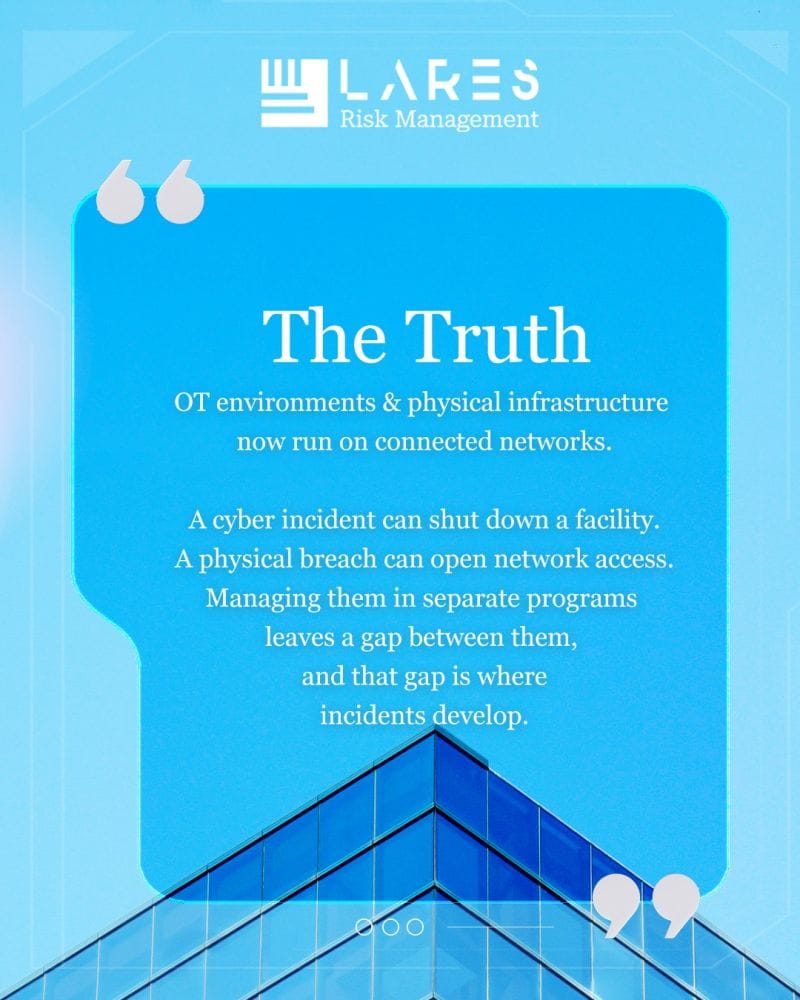
Organizations that continue to manage cyber security and physical security as separate programs often overlook how risk actually develops. The gap between these functions becomes a point of exposure.
A cyber incident can disrupt industrial operations or shut down an entire facility. Ransomware or network compromise can affect control systems, halting production or impacting safety. On the other hand, a physical breach can provide direct access to network infrastructure. Unauthorized access to servers, control panels, or network ports can bypass traditional cyber defenses.
These scenarios are no longer theoretical. They reflect how modern threats exploit the lack of coordination between teams. When responsibility is divided, accountability can become unclear, and response times slow down.
Why Integrated Security Is Now Essential
To effectively manage risk in connected environments, organizations need to align cyber security and physical security strategies. This does not always require merging teams, but it does require shared visibility, communication, and planning.
Integrated security programs allow organizations to understand how threats move across systems. They support better incident response by ensuring that both cyber and physical impacts are considered. Most importantly, they reduce the risk of blind spots between teams.
As OT environments continue to evolve, the distinction between digital and physical security will become even less relevant. Security programs need to reflect how infrastructure actually operates today, not how it functioned in the past.
Organizations that recognize this shift early are better positioned to manage risk. Those that do not often discover the consequences when an incident crosses the very boundary they assumed still existed.
For additional details, please reach out to:
📩 info@laresriskmanagement.com
🌐 Get in touch
📰 Related insights