
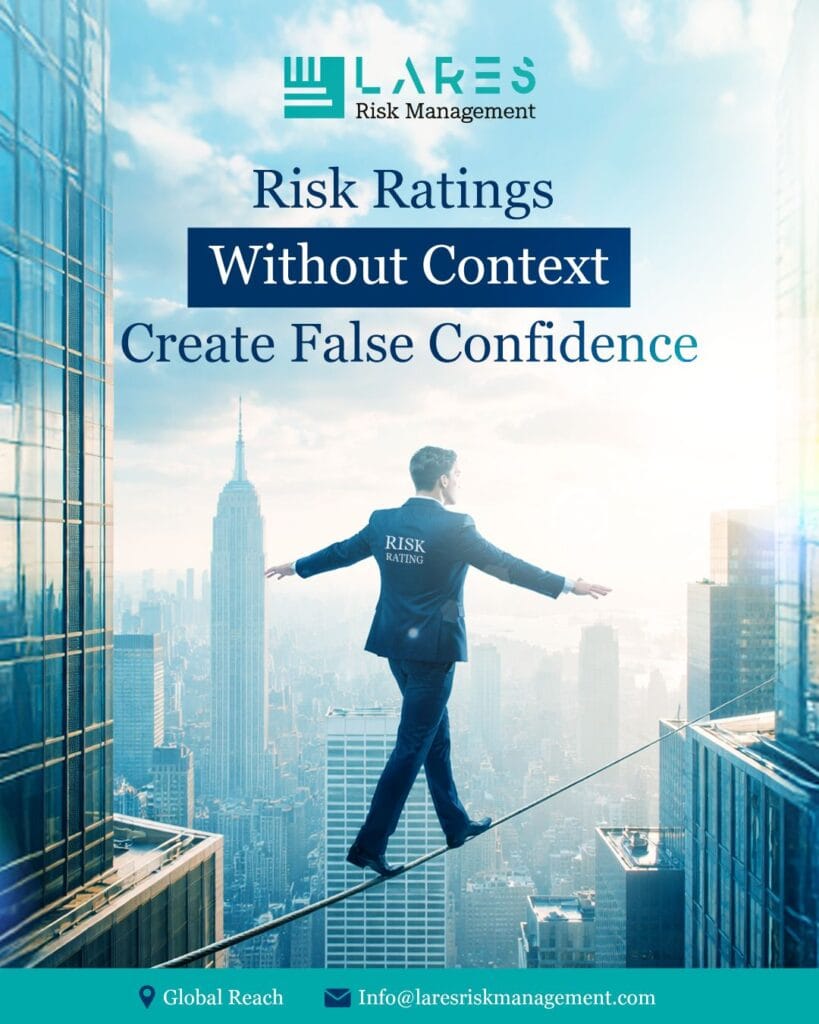
Risk ratings are often treated as final conclusions. In reality, they are only starting points.
In Threat and Vulnerability Risk Assessments (TVRAs) and Security Risk Assessments (SRAs), numerical scores and colour-coded risk matrices are widely used to simplify complex threat landscapes. These tools help organisations compare risks and prioritise actions. However, when risk ratings are removed from their operational context, they can create false confidence and distort decision-making.
A single rating such as “medium risk” does not tell the full story. The same rating can reflect vastly different levels of exposure depending on where, how, and under what conditions an organisation operates.
Why Context Matters in Security Risk Assessments
Risk does not exist in isolation. Its significance is shaped by a range of contextual factors that determine how likely a threat is to materialise and how severe the consequences could be.
Key factors that influence the true meaning of a risk rating include the operating environment and local political or security dynamics, threat intent and capability, and recent threat activity. Vulnerability exposure and the effectiveness of existing controls also play a critical role, as do timing, scale, and the potential for cascading impacts across operations, personnel, or reputation. Equally important is an organisation’s tolerance for disruption, harm, or reputational damage.
For example, a medium risk rating in a stable environment with strong security controls and rapid response capability may be acceptable. The same rating in a volatile location with limited resources, weak controls, or heightened threat activity could represent a serious operational risk that requires immediate attention.
Without this context, leadership teams may deprioritise risks that are genuinely critical, over-invest in lower-impact threats, or base strategic decisions on perceived rather than actual exposure.
Moving Beyond Scores and Risk Matrices
Effective security risk assessments do more than assign scores or populate matrices. They explain why a risk matters, how it could realistically develop, and what the consequences would be if it materialised. Most importantly, they link analysis to clear, practical decisions.
An intelligence-led approach to TVRAs and SRAs focuses on understanding threat behaviour, environmental conditions, and organisational vulnerabilities together. This approach avoids over-reliance on static scoring models and instead provides a dynamic view of risk that reflects real-world conditions.
By combining threat intelligence, vulnerability analysis, and operational insight, organisations are better equipped to prioritise resources, implement proportionate mitigation measures, and prepare for credible scenarios.
Turning Risk Ratings Into Decision Tools
When context is properly integrated, risk ratings become decision-support tools rather than abstract numbers. They help leaders understand trade-offs, allocate resources effectively, and strengthen resilience across people, assets, and operations.
At Lares Risk Management International, our approach to Threat and Vulnerability Risk Assessments and Security Risk Assessments is intelligence-led and decision-focused. Our assessments are designed to provide clarity, operational relevance, and actionable insight, ensuring that risk ratings support preparedness rather than oversimplification.
For more information on this topic:
📩 info@laresriskmanagement.com
🌐 Contact our organisation
📰 View all insights