
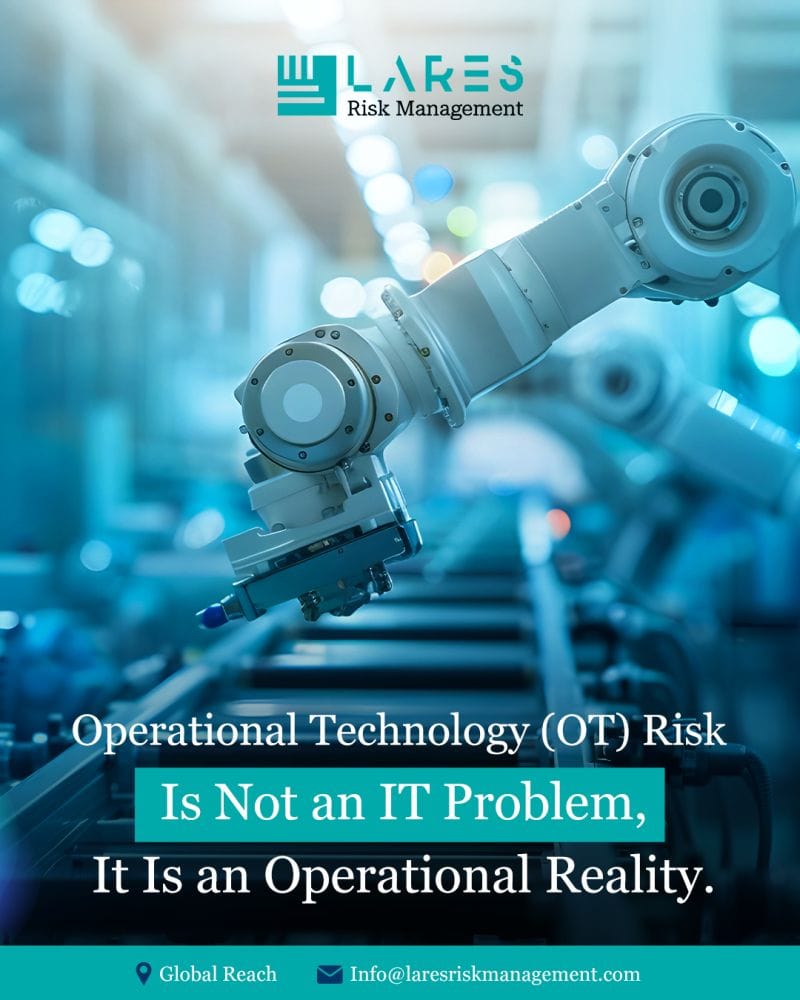
Operational Technology Risk in Manufacturing Is Not an IT Problem, It Is an Operational Reality
What Is Operational Technology (OT) Risk in Manufacturing?
In manufacturing environments, Operational Technology (OT) risk directly affects how products are made, how safely people work, and how reliably facilities perform. OT systems control production lines, robotics, process automation, industrial control systems, and safety mechanisms. When these systems fail or are compromised, the impact is immediate and tangible. Output stops, quality suffers, safety margins shrink, and recovery efforts quickly move from technical troubleshooting to operational crisis management.
Why OT Risk Goes Beyond Cybersecurity
Too often, OT risk is treated as an extension of IT security. While cyber exposure is part of the picture, manufacturing OT incidents rarely remain technical in nature. A disruption to programmable logic controllers, supervisory control systems, or process automation platforms can halt production lines, damage equipment, delay customer deliveries, and expose workers to unsafe operating conditions.
The true cost is not measured only in system recovery time, but in lost production hours, missed contractual commitments, regulatory scrutiny, and reputational damage with customers and supply chain partners.
Availability and Production Continuity as Critical Risk Factors
Manufacturing operations are particularly vulnerable because availability is critical. Unlike IT systems, many OT environments cannot be easily patched, restarted, or taken offline without significant operational consequences. Legacy equipment, long asset lifecycles, proprietary protocols, and continuous production cycles create constraints that standard IT security approaches do not always account for.
Applying controls without understanding process dependencies can introduce instability, reduce throughput, or create safety risks rather than reduce overall exposure.
Aligning OT Risk Management With Manufacturing Operations
Effective OT risk management in manufacturing requires close alignment between operations, engineering, maintenance, health and safety, and security teams. Risk assessments must focus on how failures would affect throughput, worker safety, product quality, and environmental impact, not just network vulnerabilities.
This includes maintaining accurate OT asset inventories, identifying critical production bottlenecks, understanding system interdependencies, and defining realistic recovery priorities based on operational impact rather than technical severity alone.
OT Incident Response on the Factory Floor
Incident response planning is equally important. When an OT incident occurs on the factory floor, decision-making must balance safety, continuity, regulatory obligations, and speed of recovery. Clear roles, tested escalation paths, and coordination between technical and operational teams reduce confusion during high-pressure situations.
Manufacturers that regularly exercise OT incident scenarios are far better positioned to contain disruption, protect personnel, and restore operations safely.
OT Risk as an Operational Leadership Responsibility
As manufacturing becomes more automated, connected, and data-driven, OT risk will continue to grow. Addressing it effectively means moving beyond the idea that it belongs solely to IT or cybersecurity teams. OT risk is an operational issue that demands operational leadership, governance, and accountability.
Manufacturers that recognize this reality build more resilient plants, protect their workforce, and sustain consistent delivery in an increasingly complex and high-risk operating environment.
For further information:
📩 info@laresriskmanagement.com
🌐 Contact us
📰 Other insights