
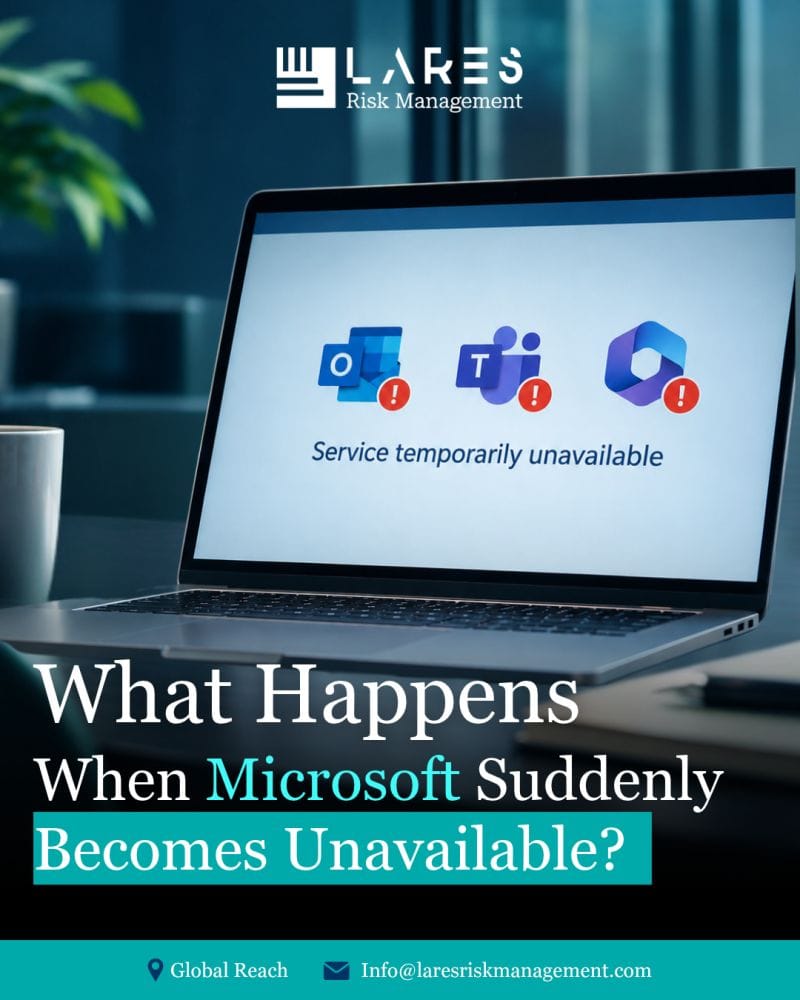
Microsoft 365 Outages: Assessing Your Organisation’s Business Continuity and Operational Resilience
The recent outage affecting Outlook, Teams and other Microsoft services raises important questions about how well organisations can maintain operations when critical technology platforms become unavailable.
For many businesses, Microsoft 365 has become central to everyday operations, supporting internal communication, document management, meetings and decision-making. While these tools improve efficiency and collaboration, their widespread use also creates dependencies that organisations may not fully recognise until a disruption occurs.
The Business Impact of Microsoft 365 Service Disruptions
When essential Microsoft services become unavailable, the consequences can extend well beyond the IT department. An important investor call may not go ahead, an executive committee meeting could be disrupted, or a commercial negotiation may be interrupted. Employees may also lose access to important documents and the communication channels they rely on to coordinate their work.
These disruptions become particularly concerning during a crisis, when timely communication and informed decisions are essential. If leadership teams cannot communicate effectively or access critical information, the organisation’s ability to respond may be significantly affected.
The impact of a technology outage is therefore not limited to lost productivity. It can also affect business operations, management decisions and the organisation’s ability to respond to unexpected events.
Business Continuity Planning and Technology Dependencies
Most organisations have business continuity plans, and many have invested considerably in backup systems and disaster recovery capabilities. However, having these arrangements in place does not necessarily mean the business is prepared to operate when its primary technology platforms become unavailable.
As organisations increasingly rely on a relatively small number of technology providers, dependencies can develop across multiple business functions. While this approach offers convenience and operational efficiency, it can also create vulnerabilities if essential services experience an outage.
A key consideration is whether existing business continuity arrangements have been tested against realistic scenarios. Organisations should understand not only how IT systems will be restored, but also how employees and management teams will continue essential activities in the meantime.
Building Operational Resilience Beyond IT Recovery
Operational resilience involves more than restoring systems after a disruption. It also concerns an organisation’s ability to maintain critical business functions while normal services remain unavailable.
This requires organisations to consider practical questions about their operational capabilities. Can leadership teams still communicate? Can critical decisions be made without access to the usual platforms? Can essential business processes continue through alternative arrangements?
These questions can help identify gaps between documented business continuity plans and the organisation’s actual ability to respond. Testing these scenarios provides an opportunity to assess whether alternative communication channels, decision-making arrangements and operational procedures are sufficiently established.
Is Your Organisation Prepared for a 24-Hour Microsoft 365 Outage?
A useful exercise for the next leadership meeting is to consider one straightforward scenario:
What would actually stop working if Microsoft 365 were unavailable for 24 hours?
More importantly, what would the organisation do about it?
Exploring this scenario can help leadership teams identify overlooked technology dependencies, assess the effectiveness of existing continuity arrangements and determine where further preparation may be necessary.
At Lares Risk Management International, we help organisations identify operational vulnerabilities, strengthen business continuity planning and build resilience against unexpected disruptions. If your organisation is reviewing its preparedness, we would be happy to discuss how we can support you.
For additional details, please reach out to:
📩 info@laresriskmanagement.com
🌐 Get in touch
📰 Related insights