
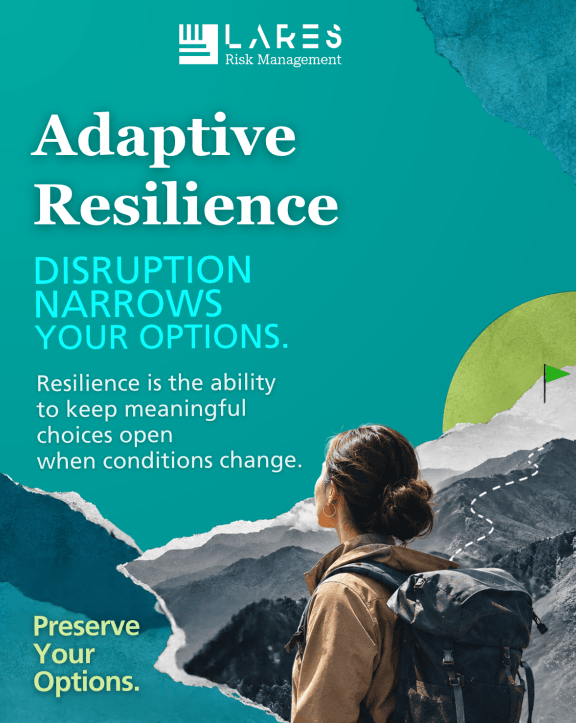
Adaptive Resilience: Preserving Organisational Options Amid Disruption
Adaptive Resilience: Keeping Organisations Prepared for Uncertainty
When disruption strikes, how many options does your organisation have left? A cyber incident, supply chain disruption or sudden geopolitical shift can challenge business continuity, disrupt operations and place leadership under pressure. These events rarely happen in isolation, and their combined impact can quickly narrow the choices available to an organisation.
Resilience is not simply about responding to incidents or recovering after disruption. It is about preserving the ability to adapt, make informed decisions and keep moving forward, even when circumstances change unexpectedly. Organisations that understand their exposure and prepare for uncertainty are better positioned to maintain control when the situation becomes more complex.
At Lares Risk Management International (LRM), our Adaptive Resilience approach connects operational support, risk management, enterprise resilience and strategic resilience to help organisations prepare for uncertainty and preserve meaningful options.
The Leadership Challenge of Managing Interconnected Risks
Risks rarely occur in isolation. A cyber incident can interrupt critical operations, a supplier failure can affect business continuity, and geopolitical developments can change the operating environment with little warning. When these pressures overlap, the challenge extends beyond managing individual incidents.
Leadership must understand how different risks interact, which activities are most critical, and how decisions made under pressure may affect the organisation’s ability to respond. Without a clear understanding of these relationships, options can become limited precisely when flexibility is most needed.
Adaptive resilience focuses on maintaining that flexibility. Rather than preparing for only one anticipated scenario, organisations need the awareness and capability to respond to changing circumstances, reassess priorities and make decisions based on the realities they face.
An Integrated Resilience Framework for Organisations
Resilience cannot exist in separate plans or disconnected functions. Operational realities should inform risk management, preparedness should support strategic decisions, and lessons from real-world experience should continuously improve how an organisation responds.
LRM’s Adaptive Resilience approach connects four complementary capabilities:
- Operational Support: Protecting people, sites and operations while supporting the activities that need to continue.
- Risk Management: Identifying, understanding and prioritising exposure to help organisations make informed decisions.
- Enterprise Resilience: Preparing for disruption, responding effectively and supporting recovery.
- Strategic Resilience: Anticipating change and preserving choices as the operating environment evolves.
Together, these capabilities provide a more connected view of organisational resilience. Instead of treating preparedness, operational support and strategic planning as separate responsibilities, organisations can consider how each influences the others and how their combined effectiveness affects decision-making during disruption.
From Risk Insight to Practical Resilience
Effective resilience requires more than another plan. It requires an understanding of what must continue, who is responsible for making decisions and which options remain available when assumptions change. Preparedness should be practical, relevant to operational realities and capable of supporting decisions when circumstances are uncertain.
LRM’s approach moves from insight to action through four stages:
- Understand
Develop an understanding of the organisation, its critical activities and its exposure to risk. This provides the foundation for identifying where disruption could have the greatest impact. - Prioritise
Identify and prioritise improvements based on urgency, exposure and practicality, helping direct attention towards areas where action matters most. - Implement & Rehearse
Put workable arrangements in place and test them through realistic exercises. Rehearsal helps organisations evaluate their preparedness and understand how plans translate into practice. - Review & Adapt
Use feedback, experience and changing conditions to review existing arrangements and renew resilience capabilities over time.
This process connects risk insight with practical implementation, ensuring preparedness remains relevant as the organisation and its operating environment evolve.
Preserving Options Through Adaptive Resilience
The objective of resilience is not simply to have more plans. It is to preserve the ability to make meaningful choices when circumstances change. Operational reality informs strategy, strategy shapes preparedness, and learning connects the two.
Organisations that approach resilience as an ongoing capability can better evaluate changing risks, understand their priorities and maintain flexibility when facing unexpected challenges. This requires a continuous connection between understanding exposure, preparing for disruption, testing arrangements and adapting to what is learned.
At Lares Risk Management International, Adaptive Resilience is about helping organisations maintain that ability to adapt, make informed decisions and move forward, even when uncertainty narrows the available choices.
Where are your organisation’s choices most at risk of narrowing?
For additional details, please reach out to:
📩 info@laresriskmanagement.com
🌐 Get in touch
📰 Related insights